$2000 Nvidia Geforce RTX 5090 gets tested on creative software and AI and obliterates absolutely everything in its path
- Nvidia's fastest GPU is unsurprisingly expensive and power hungry, just like its predecessor
- It is also extremely fast and leaves the RTX 4090 and AMD's fastest GPU, well behind
- Early benchmarks show there's far more potential once drivers and updates are rolled out
Nvidia’s latest flagship GPU, the GeForce RTX 5090, was announced at CES 2025 and has just gone on sale, although Nvidia has warned that it expects to sell out quickly. Built on the Blackwell architecture, the RTX 5090 is a successor to the RTX 4090, and features 32GB of VRAM, increased CUDA core counts, and improved memory bandwidth.
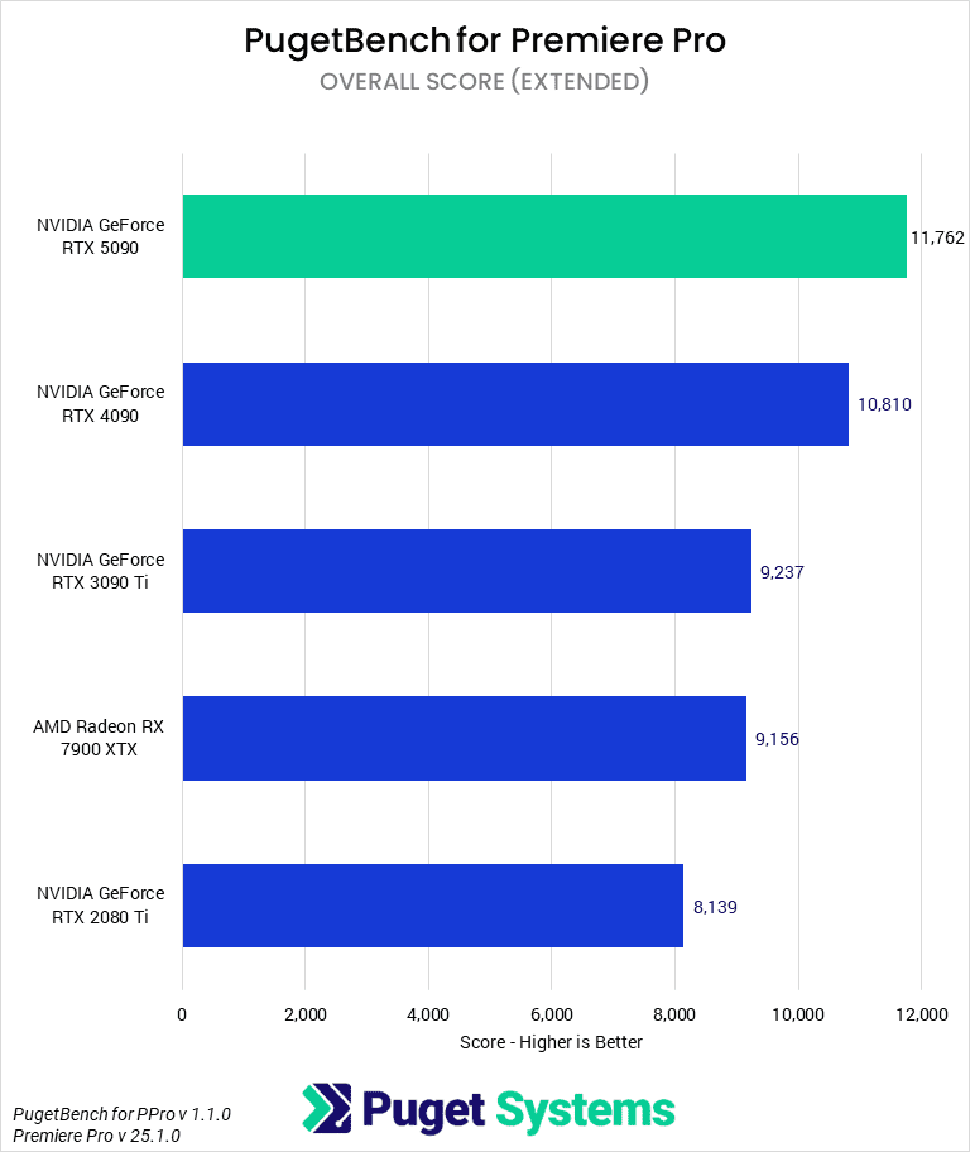
Puget Systems, which previously tested the GeForce RTX 4090, has just benchmarked the RTX 5090 across various creative applications, including Adobe Premiere Pro, After Effects, and DaVinci Resolve and as you might expect, the results were impressive.
In Premiere Pro, Puget Systems found the RTX 5090 was slightly faster than the RTX 4090 by about 9% in terms of overall performance. In Blackmagic’s DaVinci Resolve Studio, the GPU had a 17% lead over the 4090 and 35% over the 3090 Ti. Puget noted however, that the “5090 was run on a slightly different version of Resolve than the rest of the cards - a review version designed to be fully compatible with the 50-series card and which we expect to be incorporated into the application in the near future.”
Obliterating AMD
Adobe After Effects also benefits from the increased power of the RTX 5090.
According to Puget Systems, the GPU recorded a "massive 35% gen-on-gen improvement over the RTX 4090" in 3D rendering tasks, making it a solid choice for motion graphics professionals. Elsewhere, Unreal Engine benchmarks suggest the RTX 5090 leads the RTX 4090 by 17% overall. In rendering applications such as Blender and V-Ray, "the RTX 5090 is a massive 38% faster than the 4090 and three times as fast as the 3090 Ti."
The RTX 5090 outperformed AMD’s fastest consumer GPU, the Radeon RX 7900 XTX, across multiple tests, although AMD’s card faced some challenges. In Adobe After Effects, Puget Systems observed that the 7900 XTX "currently struggles with the 'Advanced 3D' renderer, with the 7900 XTX half as fast as even the 2080 Ti." It was a similar story in Unreal Engine where "AMD struggles with ray tracing, seeing a much larger performance drop than Nvidia when enabling the feature."
Despite the solid benchmarks, there are some early software compatibility issues. Puget Systems noted that "at present, the RTX 5090 is not supported in either Redshift (Cinebench) nor Octanebench" and has known performance problems in V-Ray’s CUDA rendering. Nvidia is expected to resolve these issues with future driver updates.
With a launch price of $2,000, the RTX 5090 is obviously positioned as a premium option for users who need the highest level of performance. As Puget Systems concludes, "if you need the most powerful consumer GPU ever made, this is it."
You might also like
- These are the best video cards for video editing you can buy right now
- Nvidia is preparing for the post-GPU AI era
- Geforce GPUs beat the competition in this popular video software benchmark
via Hosting & Support
Comments
Post a Comment