
The original Apple Computer cost $666.66, but you can get Steve Jobs' Polaroids of it for $2148

Web Hosting & Remote IT Support

When Apple co-founder Steve Jobs wanted to price his new Apple-1 computer, he chose a price roughly three times what it cost to build it: $666.66. The price made his cofounder and chief system designer Steve Wozniak laugh because of its proximity to a joke line he used to dial, and it ultimately caused the pair some grief because of its digit relationship to, well, the sign of the beast.

Almost 50 years later, that price is a fraction of what you might pay for Polaroid pictures of the original Apple-1 Computer prototype. A collection of three photos of the board, the board and its caseless computer, and a monitor running Apple's own brand of BASIC are on auction at RRAction House and currently sit at a bid of $2,148. The auction is open until August 22, so that price might differ by the time you visit and maybe bid.

Jobs used these images as part of his pitch deck, which he presented to early client Paul Terrell of the Byte Shop. By today's standards, the Apple-1 looked like, at best, a home-brewed system. Still, according to Walter Isaacson's Steve Jobs biography, Jobs' pitch and those images eventually convinced Terrell to sign up for an order of 50 pre-assembled Apple-1 systems.
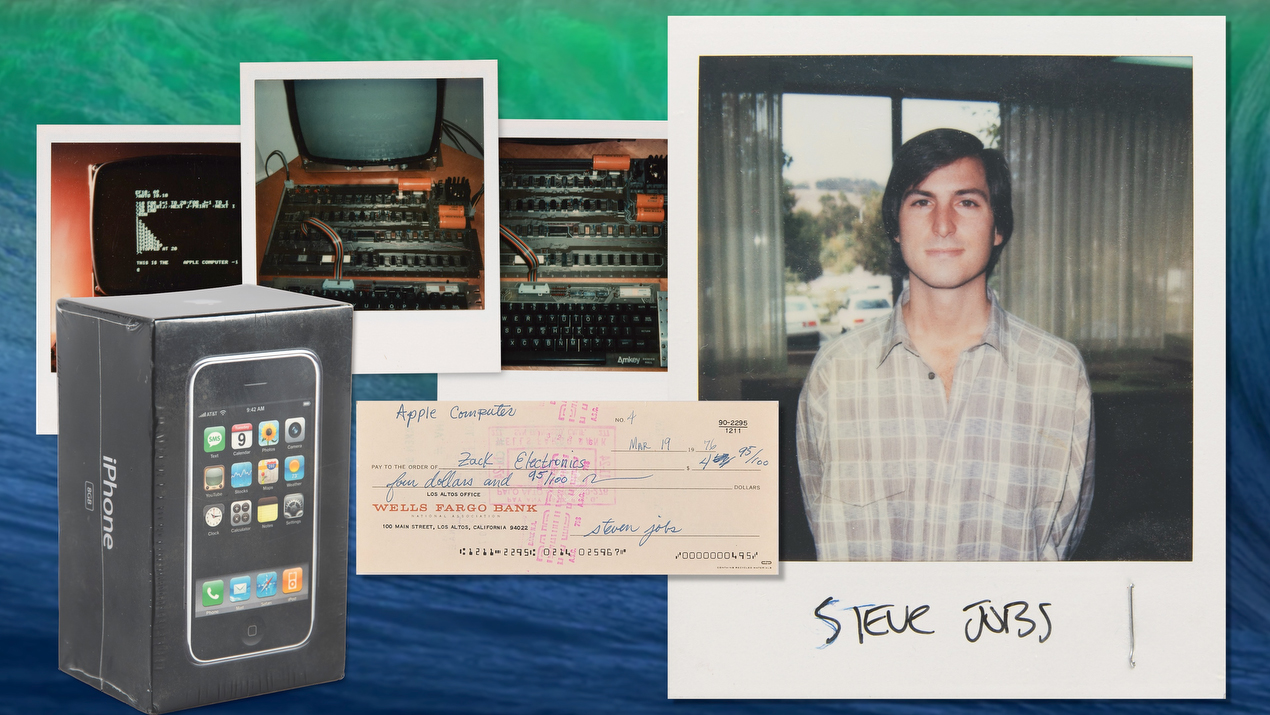
RR Auction Apple

(Image credit: RR Auction)

For that $666.66, Terrell was getting, by 1976 standards, a revolutionary 8K (expandable to 65K RAM) system that included a built-in video terminal and keyboard interface (instead of a TeleType system), that hooked up directly to a monitor or TV. There was even 1K of dedicated video memory. And then, of course, there was Apple BASIC. While it doesn't sound like much, the system sold well enough to lay the groundwork for the better-known and far more widely sold Apple II computer (I used an Apple IIe for a time and loved it).

The auction is a walk back through some of the iconic history of Apple and Steve Jobs. Along with the Polaroids, it includes a leather bomber jacket Steve Jobs wore in 1983 when photographed giving the finger to an IBM logo. IBM was, of course, a chief Apple rival in the early days of the personal computer revolution.

Other items include checks written by Jobs and even a restored and fully functional Apple-1 computer. What you can do with that system (logged as No. 104 in the Apple Computer Registry) is a fair question. It might be ready for some simple math and low-key BASIC programming, but that's about it. Still, what a museum piece.

As for those photos, since they were likely taken by Jobs himself, they're much more than a record of early personal computer efforts, they speak to how Jobs viewed their creation and how the eventual master of product marketing might've planned to market this magical piece of hardware. That's what could make it worth the cost of one of the best MacBooks.

You might also like


via Hosting & Support

Comments

Popular posts from this blog

Microsoft, Google, and Meta have borrowed EV tech for the next big thing in data centers: 1MW watercooled racks

Web Hosting & Remote IT Support Liquid cooling isn't optional anymore, it's the only way to survive AI's thermal onslaught The jump to 400VDC borrows heavily from electric vehicle supply chains and design logic Google’s TPU supercomputers now run at gigawatt scale with 99.999% uptime As demand for artificial intelligence workloads intensifies, the physical infrastructure of data centers is undergoing rapid and radical transformation. The likes of Google, Microsoft, and Meta are now drawing on technologies initially developed for electric vehicles (EVs), particularly 400VDC systems, to address the dual challenges of high-density power delivery and thermal management. The emerging vision is of data center racks capable of delivering up to 1 megawatt of power, paired with liquid cooling systems engineered to manage the resulting heat. Borrowing EV technology for data center evolution The shift to 400VDC power distribution marks a decisive break from legacy sy...

The Apple Watch ban is lifted, on appeal – but the reprieve might only be temporary

Web Hosting & Remote IT Support The Apple Watch ban story has developed quickly over the last week and a bit, and there's now a new twist: the US Court of Appeals is putting a pause on the US sales and import ban while it reviews the case, which means the Apple Watch 9 and Apple Watch Ultra 2 can go back on sale for the time being. "We are thrilled to return the full Apple Watch lineup to customers in time for the new year," an Apple spokesperson told TechRadar. "We are pleased the US Court of Appeals for the Federal Circuit has stayed the exclusion order while it considers our request to stay the order pending our full appeal." The watches in question are now once again available from "select" Apple Stores, and will also be going on sale from the Apple website from 12pm PT / 3pm ET on Thursday, December 28 (that's 8pm in the UK, and early on December 29 in Australia). All Apple Stores should have stock by the weekend. As for how long t...

The Samsung Galaxy Ring could go into production as soon as next month

Web Hosting & Remote IT Support With the dust beginning to settle from the huge Samsung Unpacked 2023 event, we can turn our attention towards what Samsung might have planned next: and a smart ring seems to be in the company's near future. As per a report from South Korean outlet The Elec (via SamMobile ), mass production on a Samsung Galaxy Ring could begin as early as August, with a decision imminent on the schedule for getting the wearable manufactured and out to consumers. A full launch is slated for some point during 2024 though, rather than 2023. The nature of the device means that it'll need to clear several regulatory hurdles before it can go on sale and start tracking various vital statistics. An early 2024 launch would put the Galaxy Ring on a similar schedule to the Samsung Galaxy S24 – and it would therefore make sense to launch both gadgets at the same time, perhaps in January or February if Samsung follows its 2023 routine. The story so far Rumors ar...