
Amazon tests a new AI assistant to answer your questions while you shop

Web Hosting & Remote IT Support

Amazon is reportedly testing a new AI assistant on its mobile app that can answer customer questions about specific products.

This feature appears to have been initially discovered by e-commerce research firm Marketplace Pulse. According to the firm, the AI can be found under the “Looking for specific info?” section on product pages. The LLM (large language model) powering the feature relies on listing details provided by companies and user reviews to generate responses to inquiries. For example, you can ask if a particular workout shirt is good for running or if it fits well on a tall person. Marketplace Pulse states its main purpose is to save people the trouble of having to read individual reviews by summarizing all the information present into a succinct block of text. 
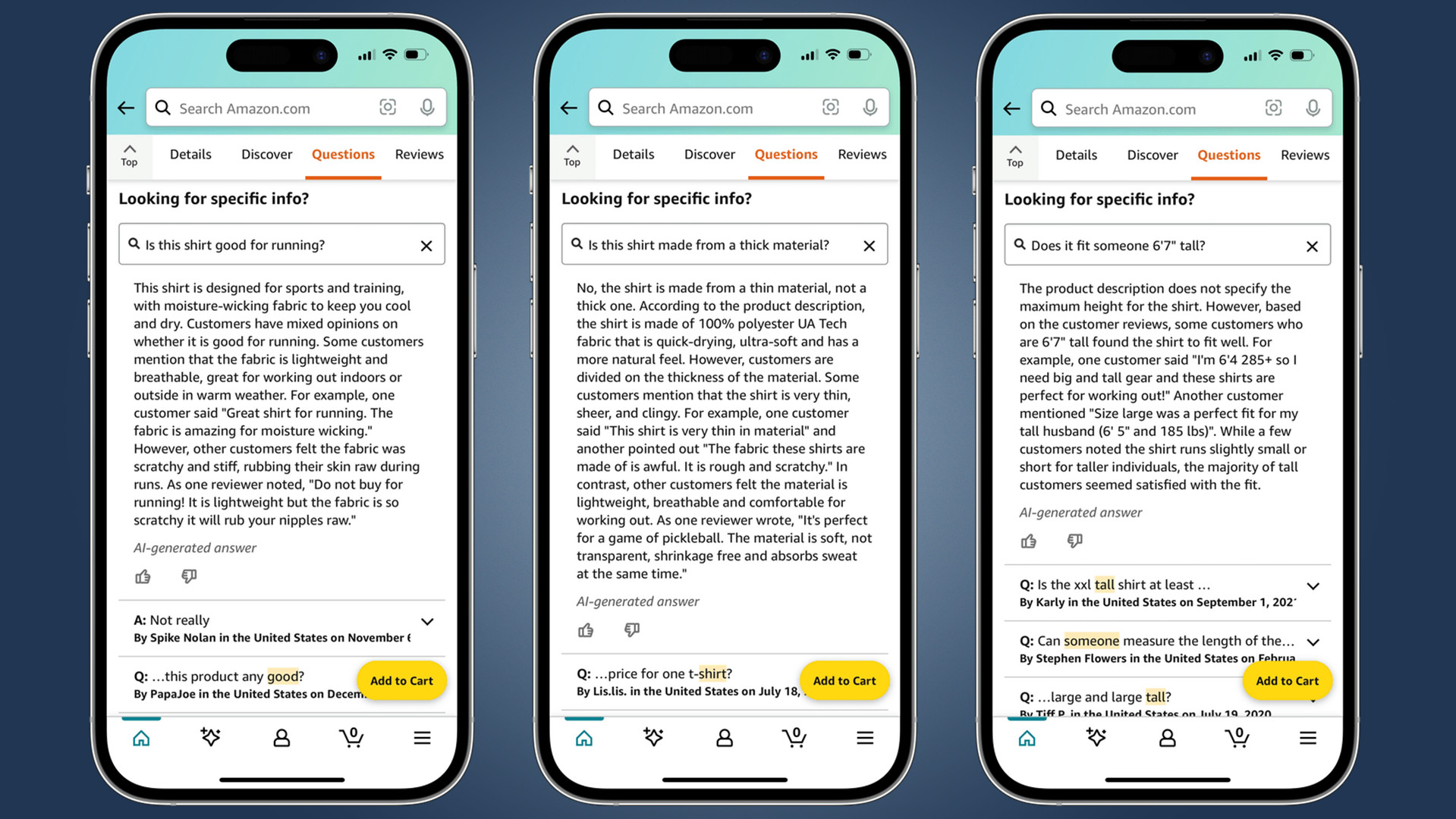
Amazon AI assistant

(Image credit: Marketplace Pulse/Amazon)

Because it’s in the early stages, the AI assistant is limited in what it can do. You can’t command it to compare two items or “find alternatives.” Although it can’t recommend specific products, Amazon’s chatbot can make soft suggestions. In another example, MarketPlace Pulse asked the app assistant if e-bikes are good for romantic dates. The AI said “not really” and recommended buying a tandem bike instead.

Quirks and unintended features

There are several quirks affecting the chatbot. Unsurprisingly, it’s “prone [to] hallucinating wrong information” about an item. MarketPlace Pulse even claims it outright refused to “answer basic questions”. What’s more, the assistant is capable of answering prompts that apparently “Amazon didn’t build it for.” 

It can generate Python code, write jokes about a product, or answer in languages besides English. CNBC had access to the test and was reportedly successful in describing items “in the style of Yoda from Star Wars.” Despite these abilities, you can’t hold a regular conversation with the AI like you could with ChatGPT.

Amazon's AI assistant quirks

(Image credit: Marketplace Pulse/Amazon)

It’s unknown how widespread the test is. We didn't have access on our phone. Amazon hasn’t said anything official so far, but we reached out to the platform asking for more information about the AI. We also asked Marketplace Pulse if it knows whether the assistant is available to a lot of people or just a select group. This story will be updated at a later time.

Alexa upgrade

Amazon’s AI ambitions don’t stop there as a report from Business Insider reveals the tech giant is currently working on a revamped and paid version of Alexa. The upgrade is called Alexa Plus, which is said to offer a “more conversational and personalized” experience akin to ChatGPT.

The team is aiming to launch Alexa Plus on June 30, according to the report. Unfortunately, development is not going smoothly. A source with intimate knowledge told Business Insider the revamp is “falling short of expectations”. The AI is reportedly hallucinating false information as the team is having a hard time getting the tech to work properly. The project may also be causing a lot of internal fighting with some arguing people are not going to want to pay for another Amazon service.

At a glance, it seems Alexa Plus might miss the June 30 deadline.

If you want your own digital sidekick, check out TechRadar's list of the best AI-powered virtual assistants.

You might also like


via Hosting & Support

Comments

Popular posts from this blog

Microsoft, Google, and Meta have borrowed EV tech for the next big thing in data centers: 1MW watercooled racks

Web Hosting & Remote IT Support Liquid cooling isn't optional anymore, it's the only way to survive AI's thermal onslaught The jump to 400VDC borrows heavily from electric vehicle supply chains and design logic Google’s TPU supercomputers now run at gigawatt scale with 99.999% uptime As demand for artificial intelligence workloads intensifies, the physical infrastructure of data centers is undergoing rapid and radical transformation. The likes of Google, Microsoft, and Meta are now drawing on technologies initially developed for electric vehicles (EVs), particularly 400VDC systems, to address the dual challenges of high-density power delivery and thermal management. The emerging vision is of data center racks capable of delivering up to 1 megawatt of power, paired with liquid cooling systems engineered to manage the resulting heat. Borrowing EV technology for data center evolution The shift to 400VDC power distribution marks a decisive break from legacy sy...

Google’s AI Mode can explain what you’re seeing even if you can’t

Web Hosting & Remote IT Support Google’s AI Mode now lets users upload images and photos to go with text queries The feature combines Google Gemini and Lens AI Mode can understand entire scenes, not just objects Google is adding a new dimension to its experimental AI Mode by connecting Google Lens's visual abilities with Gemini . AI Mode is a part of Google Search that can break down complex topics, compare options, and suggest follow-ups. Now, that search includes uploaded images and photos taken on your smartphone. The result is a way to search through images the way you would text but with much more complex and detailed answers than just putting a picture into reverse image search. You can literally snap a photo of a weird-looking kitchen tool and ask, “What is this, and how do I use it?” and get a helpful answer, complete with shopping links and YouTube demos. AI Eyes If you take a picture of a bookshelf, a plate of food, or the chaotic interior of your junk...

Passing the torch to a new era of open source technology

Web Hosting & Remote IT Support The practice of developing publicly accessible technologies and preventing monopolies of privately-owned, closed-source infrastructure was a pivotal technological movement in the 1990s and 2000s. The open source software movement was viewed at the time as a form of ‘digital civil duty’, democratizing access to technology. However, while the movement's ethos underpins much of today’s technological landscape, its evolution has proven to be a challenge for its pioneers. Hurdles Facing Young Developers Open source models successfully paved a path for the development of a multitude of technologies, cultivating a culture of knowledge sharing, collaboration , and community along the way. Unfortunately, monetizing such projects has always been a challenge, and ensuring contributors are compensated for their contributions working on them, even more so. On the other hand, closed-source projects offer greater control, security, and competitive advant...